
What Tennis Shoes to Wear on Different Court Surfaces
Tennis footwear should support repeated starts, stops, and side-to-side movement. Court surface matters, but it is only part of the decision. Fit, playing style, condition of the court, and venue rules also affect which tennis shoes are appropriate.
Product names are not standardized across every brand. Check the manufacturer's surface label and outsole description, and ask the facility whether it restricts tread patterns or shoe colors. No shoe can guarantee grip or prevent injury on a wet, damaged, contaminated, or poorly maintained court.
Hard courts
A hard-court shoe usually emphasizes outsole durability and multidirectional stability. Players who frequently wear through the toe or medial forefoot may prefer reinforcement in those areas. Cushioning is a matter of fit and feel rather than a promise of protection; compare models while making the stops and lateral movements used in tennis.
An all-court tennis shoe is often designed primarily around hard-court use and may be a practical choice for players who use several surfaces. Confirm the manufacturer's description instead of assuming any general athletic shoe is suitable. Running shoes are designed mainly for forward movement and usually are not a substitute for court shoes during tennis.
Clay courts
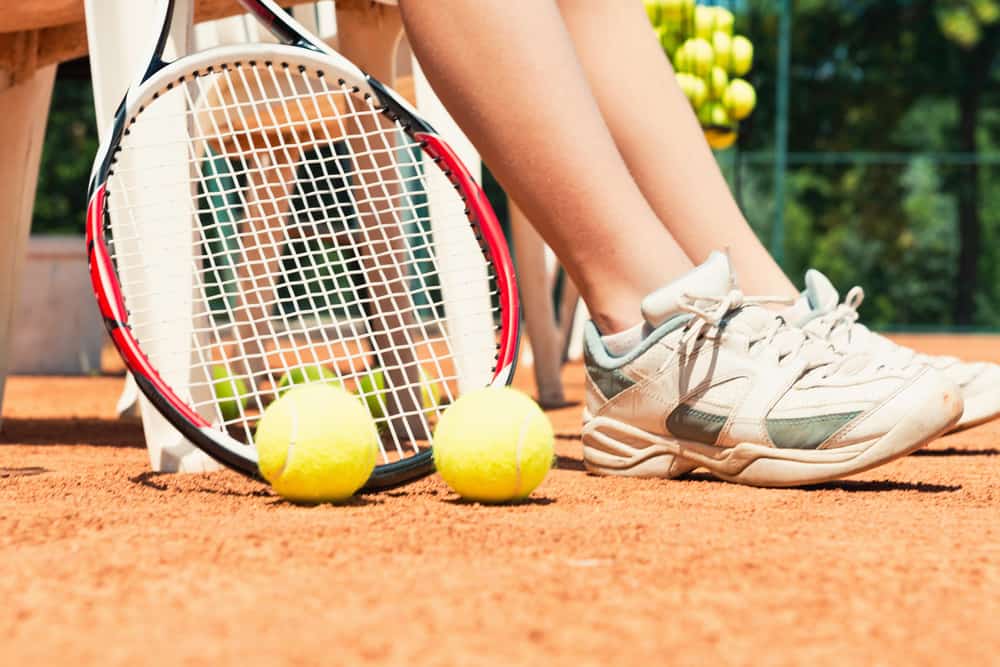
Clay-specific shoes commonly use a tread pattern designed to manage loose clay and provide more predictable release during movement. A full herringbone-style pattern is common, but exact designs vary. The upper may be built to limit clay entry and hold the foot during lateral movement.
Do not treat maximum grip as the goal: excessive or inconsistent traction can also disrupt movement. Keep the outsole clear according to facility rules, and stop play if the surface is wet, uneven, or otherwise unfit. Some venues permit all-court shoes on clay; check before buying a separate pair.
Natural grass courts
Grass tennis remains an active competitive surface. Grass-court shoes may use a fine, low-profile dimple or pimple pattern intended to provide traction without damaging the turf. The court operator or tournament determines what is allowed, and grass outsoles may require approval. Do not use aggressive lugs, cleats, or improvised studs unless the venue and governing rules explicitly allow that footwear.
Grass conditions can change with moisture and wear. Surface-specific shoes do not make a slippery court safe, so follow the operator's decision about whether play can continue.
Artificial grass, carpet, and indoor surfaces
Artificial grass is not interchangeable with natural grass. Sand-filled synthetic turf, textile carpet, acrylic indoor courts, and modular tiles can call for different outsole properties. Some indoor facilities require non-marking soles or prohibit patterns that catch the surface. Use the shoe manufacturer's stated surface compatibility together with the venue's rules.
Fit checks for every surface
- Try both shoes with your usual tennis socks and any prescribed orthoses.
- Allow toe room while keeping the heel and midfoot secure during lateral movement.
- Check that the upper does not pinch, crease painfully, or allow the foot to slide over the sole.
- Inspect the outsole and upper regularly; uneven wear or lost tread can change how the shoe behaves.
- Replace or reassess shoes based on condition and performance, not an arbitrary price or calendar rule.
Persistent pain, instability, or recurrent injury is not a problem to solve through surface labels alone. A qualified healthcare professional can assess symptoms, while a tennis coach or facility professional can clarify movement demands and local court rules.